Kaiser Permanente Sepsis Protocol: How SEWS Works
The Kaiser Permanente sepsis protocol uses a 5-element SEWS screening tool to reduce mortality. Learn how nurses apply it and what outcomes data shows.
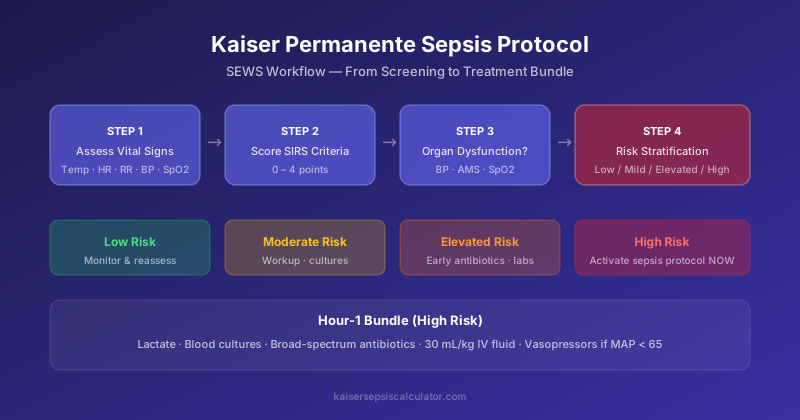
Sepsis kills one in five patients in intensive care units worldwide. That number isn't inevitable. It's a target. Kaiser Permanente demonstrated this as forcefully as any health system in the United States, building a systematic screening and response infrastructure that caught sepsis earlier, treated it faster, and measurably reduced the death rate across a patient population of millions.
The story of the Kaiser Permanente sepsis protocol is a story about what happens when a large integrated health system decides to treat sepsis the way aviation treats safety: with checklists, standardized criteria, and a culture where any team member can trigger an escalation.
The Mortality Problem That Drove the Protocol
Kaiser Permanente Northern California (KPNC) began its systematic sepsis work in the mid-2000s after an internal review revealed that sepsis outcomes across its hospitals varied significantly, and that variation was not explained by patient acuity. Some hospitals were diagnosing sepsis faster than others. Some were delivering antibiotics within one hour. Many were not.
The internal mortality data made the case for action. Sepsis-related hospital mortality in the pre-protocol period ran above 20% for severe sepsis cases in the Kaiser system, in line with national rates but not acceptable to a system with the infrastructure to do better. The Surviving Sepsis Campaign had published its initial guidelines in 2004, and the evidence base for early intervention was growing rapidly.
The KPNC team, working with nurses, hospitalists, emergency physicians, and intensivists, set out to build a protocol that was at once sensitive enough to catch early sepsis, specific enough to avoid overwhelming clinical resources with false alarms, and operationally simple enough for a bedside nurse to apply at shift start without a physician order.
The Five Elements of SEWS
The Sepsis Early Warning Score developed within Kaiser Permanente doesn't use a single numeric threshold. Instead, it uses a five-element structured screening checklist applied by nursing staff at defined intervals, typically every shift or with any change in patient condition.
The five elements target the same physiologic territory as SIRS criteria but are organized specifically for bedside nurse documentation workflows:
1. Temperature abnormality. Fever above 38°C (100.4°F) or hypothermia below 36°C (96.8°F). The protocol treats both ends of the temperature spectrum as equivalent flags, consistent with the SIRS framework and the clinical evidence that hypothermic sepsis carries at least as much mortality risk as febrile sepsis.
2. Tachycardia. Heart rate above 90 bpm. Nurses are instructed to use a resting rate measured with the patient supine for at least two minutes, reducing false positives from ambulation or procedural stress.
3. Tachypnea. Respiratory rate above 20 breaths per minute, with the protocol specifying a full 60-second counted rate rather than a 15-second extrapolation. This standard was adopted after internal data showed that estimated respiratory rates were systematically under-recording true tachypnea on general wards.
4. Altered mental status. Any new confusion, agitation, somnolence, or decline from the patient's documented baseline mental status. The protocol emphasizes documentation of a baseline on admission so that later changes can be compared to a known reference point rather than assessed in isolation.
5. Suspected or confirmed infection. A clinical judgment criterion that a physician, nurse practitioner, or physician assistant has documented suspicion of an infectious source, whether community-acquired or healthcare-associated. This is the element that converts a SIRS-positive screen into a sepsis alert rather than a general physiologic abnormality.
A patient who meets two or more of the first four criteria AND criterion five (suspected infection) triggers a formal SEWS alert in the electronic health record and initiates the interdisciplinary response protocol.
How Nurses Apply SEWS at the Bedside
The operational power of the Kaiser Permanente protocol is that it puts screening authority in nursing hands. A nurse doesn't need a physician present to recognize a SEWS-positive patient and trigger an alert. The protocol explicitly designates this as a nursing assessment and response action.
During each shift assessment, and any time a patient's condition changes, the nurse documents the five SEWS elements in the EHR. The system automatically calculates whether the threshold is met. If so, a tiered alert fires:
Level 1 alert. Two criteria met with suspected infection, no hemodynamic instability. The response includes a mandatory bedside physician evaluation within 30 minutes, blood cultures (two sets), stat lactate measurement, and antibiotic order within one hour.
Level 2 alert. Three or more criteria, or any hemodynamic compromise (systolic BP <90 or MAP <65), or lactate ≥2 mmol/L. The response escalates to include intensivist notification, fluid resuscitation initiation (30 mL/kg crystalloid bolus within 3 hours), and consideration for ICU transfer.
Level 3 alert. Vasopressor requirement or lactate >4 mmol/L. This triggers automatic ICU transfer, critical care consultation, and activation of the full septic shock bundle.
Each alert level carries specific time targets aligned with the Surviving Sepsis Campaign bundles: antibiotics within one hour for Level 2/3, cultures before antibiotics in all cases, lactate re-measurement at 2 hours if initial lactate is abnormal.
The interdisciplinary response team (bedside nurse, charge nurse, hospitalist or ED physician, and pharmacist) is assembled based on alert level. For Level 2 and 3, a rapid response nurse is automatically dispatched to assist with IV access, specimen collection, and medication administration, reducing the workload on the primary bedside nurse.
What the Outcomes Data Shows
Kaiser Permanente published outcomes data from the SEWS implementation in multiple analyses. The most frequently cited is the Whippy et al. retrospective cohort analysis (*The Permanente Journal*, 2011) covering the Northern California region.
Key findings from the KPNC sepsis initiative:
- Hospital mortality from sepsis declined from 21.5% to 14.7% between the pre-protocol period and the period after full SEWS implementation, a relative risk reduction of approximately 32%.
- Time to antibiotic administration decreased from a median of 4.9 hours in the pre-protocol period to 1.7 hours after implementation.
- Blood culture collection before antibiotics increased from 63% of sepsis cases to 87%, improving pathogen identification rates and enabling appropriate antibiotic de-escalation.
- Lactate measurement within 3 hours increased from 42% to 81% of sepsis cases, enabling earlier identification of cryptic shock.
A later analysis covering the broader implementation period reported that the KPNC sepsis program prevented an estimated 500 deaths per year across the Northern California region alone, translating to meaningful reductions in both mortality and sepsis-related ICU days.
The results were replicated in other Kaiser regions. Kaiser Permanente Southern California and mid-Atlantic regions implemented similar protocols with comparable mortality reductions, establishing the SEWS approach as a system-wide standard rather than a single-hospital success.
The Role of the Electronic Health Record
Kaiser Permanente's integrated EHR infrastructure (HealthConnect, built on Epic) was a critical enabler of the SEWS protocol. The system could automatically calculate SEWS scores from documented vital signs, fire real-time alerts visible to both the bedside nurse and the charge nurse, track time-to-alert and time-to-intervention metrics, generate sepsis bundle compliance dashboards, and flag when bundle elements weren't completed within target windows.
Hospitals without integrated EHR infrastructure have implemented paper-based SEWS equivalents with similar screening criteria, but the real-time alert functionality and compliance tracking that drove Kaiser's outcomes improvements required EHR integration. The sepsis alert couldn't be ignored or overlooked. It appeared in the nursing workflow and required active acknowledgment and a documented response.
This EHR integration also enabled continuous quality improvement. Monthly compliance reports allowed unit managers to identify which nursing units or shifts had lower SEWS trigger rates, investigate whether under-documentation was contributing, and implement targeted education. The system could also flag cases where SEWS was negative but the patient subsequently developed confirmed sepsis, a retrospective learning loop that refined screening thresholds over time.
Why This Protocol Matters Beyond Kaiser
The Kaiser Permanente SEWS protocol matters for the broader clinical community for two reasons.
First, it demonstrated that sepsis mortality is modifiable at scale. The 14–32% relative mortality reductions achieved across millions of patients, consistently replicated across multiple regions and hospital types, established that early systematic screening and standardized response aren't theoretical benefits. They are achievable in real-world operations.
Second, the nurse-driven trigger model has influenced sepsis protocol design far beyond Kaiser Permanente. The principle that any bedside nurse should have both the authority and the structured tool to escalate a sepsis concern, without waiting for a physician to notice the vital sign trends, is now embedded in the Surviving Sepsis Campaign guidelines, the SEP-1 bundle requirements, and many state-level sepsis regulations.
For a detailed breakdown of how SIRS criteria (the physiologic foundation of the SEWS screening elements) are defined and thresholded, see our post on the four SIRS criteria and their exact measurement standards.
For information on what happens after a sepsis alert fires (the specific bundle elements, time targets, and antibiotic selection principles), see our post on the sepsis treatment bundle and what each element targets.
Applying the Same Logic at the Bedside
The SEWS framework is operationally accessible even outside the Kaiser system. Any clinician can apply the same five-element logic (temperature, heart rate, respiratory rate, mental status, suspected infection) using nothing more than a thermometer, a watch, and clinical observation.
The structured approach matters because it counters the cognitive bias toward premature closure. A patient who has been febrile for two days and was "watched" yesterday is easy to dismiss as the same. A structured five-element SEWS check on morning rounds re-evaluates all criteria from scratch, regardless of yesterday's assessment.
If you want to apply this structured screening logic to a current clinical case, calculate your sepsis risk score with the Kaiser Sepsis Calculator to work through each SIRS-equivalent criterion in a standardized format.
For clinicians without access to an automated alert system, our sepsis risk calculator replicates the five-element SEWS screening logic in a free, browser-based tool that requires no login or software installation.
For more on the evidence-based approach behind this tool, visit our team and methodology overview.