The Sepsis Treatment Bundle: First 3 Hours Explained
The sepsis treatment bundle covers blood cultures, antibiotics, fluids, and lactate in a tight time window. Learn what each step does and why timing is everything.
Sepsis kills through speed. The pathophysiology moves faster than most clinical workups. Organ dysfunction can be irreversible within hours of the initial insult. The sepsis treatment bundle exists because scattered, delayed, or incomplete responses have consistently worse outcomes than protocol-driven care delivered on a tight clock.
Understanding what the bundle requires, why each element was chosen, and where the evidence is strong versus contested makes clinicians more effective when the protocol matters most.
From 3-Hour Bundle to Hour-1 Bundle
The original Surviving Sepsis Campaign bundles, introduced in 2004, separated interventions into a 3-hour bundle and a 6-hour bundle. The 3-hour bundle covered blood cultures, antibiotics, lactate, and initial fluid resuscitation. The 6-hour bundle added vasopressors, repeat lactate measurement, and central venous monitoring.
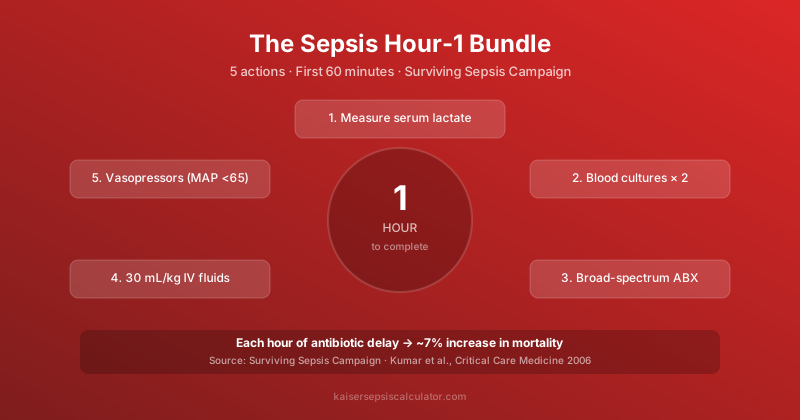
In 2018, the Surviving Sepsis Campaign collapsed these into a single Hour-1 Bundle. Five elements, to be initiated (not necessarily completed) within the first hour of sepsis recognition. The revision was driven by data from the New York State Sepsis Initiative, which showed that faster bundle completion correlated with significantly lower mortality (Seymour et al., *NEJM*, 2017).
The change wasn't without controversy. Critics argued the Hour-1 Bundle could lead to harm through excessive early fluid loading and that the evidence base was observational rather than randomized. The debate continues in critical care circles, but the Hour-1 framework is now the standard in most major health systems.
The 5 Elements of the Hour-1 Bundle
1. Measure Lactate
Lactate is a marker of tissue hypoperfusion. Elevated lactate, even with normal blood pressure, signals that cells are not receiving adequate oxygen delivery. A lactate ≥2 mmol/L indicates increased sepsis risk. A value ≥4 mmol/L defines septic shock in the Sepsis-3 framework regardless of blood pressure.
The clinical importance of lactate goes beyond diagnosis. Lactate clearance, defined as a decrease of ≥10% over 2 hours, is an independent predictor of survival and guides resuscitation endpoints. Patients who fail to clear lactate despite adequate fluids and vasopressors have significantly worse outcomes.
If initial lactate is ≥2 mmol/L, the bundle calls for repeat measurement within 2 hours.
2. Obtain Blood Cultures Before Antibiotics
Blood cultures must be drawn before the first antibiotic dose. This is non-negotiable from a diagnostic standpoint. Antibiotics begin sterilizing blood within 30–60 minutes of administration, and a positive culture is the only way to definitively identify the causative organism and guide de-escalation therapy.
The practical instruction is two sets of cultures from two separate venipuncture sites, not two draws from the same line. Each set includes an aerobic and an anaerobic bottle. Time from culture collection to antibiotic administration should be minimized. The goal is cultures drawn and antibiotics initiated within the same short window.
Do not delay antibiotics to wait for cultures if there will be a significant time gap. The mortality cost of delayed antibiotics outweighs the microbiological benefit of waiting.
3. Administer Broad-Spectrum Antibiotics
Antibiotic timing is the most time-sensitive element of the bundle. The landmark data comes from Kumar et al. (*Critical Care Medicine*, 2006): in septic shock, each hour of delay in effective antibiotic administration was associated with a 7.6% average decrease in survival. A patient who receives antibiotics at hour 6 instead of hour 1 has dramatically worse odds.
More recent data from Seymour et al. (*NEJM*, 2017) confirmed that completing the 3-hour bundle in under 3 hours was associated with lower in-hospital mortality (adjusted OR 0.85), with antibiotic timing being among the strongest individual predictors.
Antibiotic selection follows the principle of empirical broad-spectrum coverage tailored to:
- The likely source (pulmonary, abdominal, urinary, skin/soft tissue)
- Local resistance patterns (antibiogram)
- Patient-specific risk factors (immunocompromise, recent hospitalizations, prior resistant organisms)
- Allergy history
Common empirical regimens for sepsis of unknown source include:
- Piperacillin-tazobactam 4.5g IV q6–8h (covers most gram-negatives and anaerobes)
- Meropenem 1g IV q8h (broader coverage when resistant organisms are a concern)
- Vancomycin added when MRSA coverage is needed
De-escalation, meaning narrowing to targeted therapy based on culture results, should begin at 48–72 hours. Unnecessary broad-spectrum antibiotics drive resistance, C. difficile infection, and adverse drug effects.
4. Administer 30 mL/kg Crystalloid for Hypotension or Lactate ≥4 mmol/L
Fluid resuscitation addresses the hypovolemia and venodilation that characterize septic physiology. The 30 mL/kg body weight target for crystalloid administration comes from the ProCESS, ARISE, and ProMISe trials: three landmark randomized controlled trials published in 2014–2015 that together enrolled over 3,700 patients.
Those trials found no mortality difference between protocol-based resuscitation (including a central venous pressure target) and usual care, but confirmed that adequate early fluid administration remained important. The 30 mL/kg figure approximates the fluid deficit in many septic patients and represents a pragmatic starting point.
Isotonic crystalloid, either normal saline (0.9% NaCl) or lactated Ringer's, is the recommended fluid. The SMART trial (Semler et al., *NEJM*, 2018) showed balanced crystalloids (Ringer's or PlasmaLyte) were associated with lower rates of major adverse kidney events compared to normal saline, particularly in ICU patients. Many institutions have shifted to balanced crystalloids as first-line.
The 30 mL/kg target is a starting point, not a fixed goal. Patients with cardiogenic comorbidities or evidence of volume overload require reassessment after each fluid bolus using dynamic markers: pulse pressure variation, inferior vena cava collapsibility, or passive leg raise response.
5. Apply Vasopressors for MAP <65 mmHg
When fluid resuscitation alone cannot maintain a mean arterial pressure (MAP) ≥65 mmHg, vasopressors are indicated. The MAP target of 65 mmHg was established by the SEPSISPAM trial (Asfar et al., *NEJM*, 2014), which showed no mortality benefit from targeting higher MAP (80–85 mmHg) in most patients. Patients with chronic hypertension may benefit from higher targets to protect renal perfusion.
Norepinephrine is the first-line vasopressor for septic shock. This is consistent with Surviving Sepsis Campaign guidelines, the SOAP II trial (De Backer et al., *NEJM*, 2010), and subsequent meta-analyses. Dopamine is associated with higher rates of arrhythmia and is no longer recommended as first-line.
Vasopressors are typically administered through a central venous catheter, though peripheral administration is acceptable for short periods during central line placement if the clinical situation demands.
Why Timing Is the Dominant Variable
Every element of the bundle has its own evidence base, but the thread connecting all five is time. The Rhee et al. analysis of over 49,000 sepsis patients in *JAMA* (2019) found that completion of the 3-hour bundle within 3 hours was associated with significantly lower in-hospital mortality compared to completion between 3–12 hours. The effect was consistent across sepsis severity levels.
The mechanism is straightforward: organ dysfunction in sepsis is driven by microvascular failure, mitochondrial dysfunction, and apoptosis. These processes begin within minutes of the initial hemodynamic insult and become increasingly difficult to reverse as time passes. The earlier the intervention, the more reversible the injury.
If you suspect sepsis, use our sepsis risk calculator to screen quickly before initiating the bundle. Early identification is the prerequisite for early treatment.
Controversies and Evolving Evidence
The Hour-1 Bundle isn't universally accepted. The main criticisms:
Fluid overload risk. Aggressive early resuscitation may harm patients with congestive heart failure, renal failure, or ARDS. The CLASSIC trial (Hjortrup et al., *Intensive Care Medicine*, 2016) and SMART-ACS data support more conservative fluid strategies in select patients.
Antibiotic stewardship tension. Mandatory broad-spectrum antibiotics within 1 hour may drive over-treatment in patients where sepsis is uncertain. The SEP-1 quality measure has been criticized for penalizing clinicians who appropriately delay antibiotics while confirming the diagnosis.
Source control. The bundle doesn't explicitly address source control, meaning surgical drainage, catheter removal, or debridement of infected tissue. This is the fifth pillar of sepsis management and arguably as important as antibiotics in patients with abscess, necrotizing fasciitis, or other anatomic infections.
Linking Severity to Treatment
The treatment bundle applies to all sepsis patients, but the intensity of monitoring and intervention scales with severity. For a full comparison of how clinical severity categories map to treatment decisions, see our post on septic shock vs. severe sepsis.
Recognizing sepsis before the patient deteriorates to shock is the best way to improve outcomes. Knowing the early warning signs of sepsis allows clinicians to trigger the bundle sooner, before lactate climbs and blood pressure falls.
After the First Hour
Bundle initiation is only the beginning. Reassessment at 2–3 hours should include:
- Repeat lactate if initial value was elevated
- Blood pressure response to fluids and vasopressors
- Urine output (target ≥0.5 mL/kg/hr)
- Repeat physical examination for new signs of deterioration
ICU admission criteria vary by institution, but any patient requiring vasopressors, with lactate ≥4 mmol/L, or with failure of initial resuscitation warrants critical care consultation or transfer.
Learn more about how our editorial team reviews clinical content on our clinical methodology page.
Summary
The Surviving Sepsis Campaign Hour-1 Bundle gives clinicians a structured response to a disease that punishes delay. Blood cultures before antibiotics, broad-spectrum antibiotics within the first hour, 30 mL/kg crystalloid for hemodynamic compromise or high lactate, vasopressors for MAP below 65, and repeat lactate measurement. These five steps represent the strongest available evidence for early sepsis management.
The bundle isn't a substitute for clinical judgment. It's a scaffold that ensures the most time-sensitive interventions are not omitted under pressure. Use it as a baseline, adjust for the individual patient, and reassess continuously. Before bundle initiation, check the SIRS score calculator to confirm which criteria are present and document the time of sepsis recognition.