SIRS Criteria Explained: 4 Measurements That Flag Risk
SIRS criteria use 4 vital sign and lab thresholds to screen for sepsis risk. Learn each cutoff, how scoring works, and where SIRS has clinical limits.
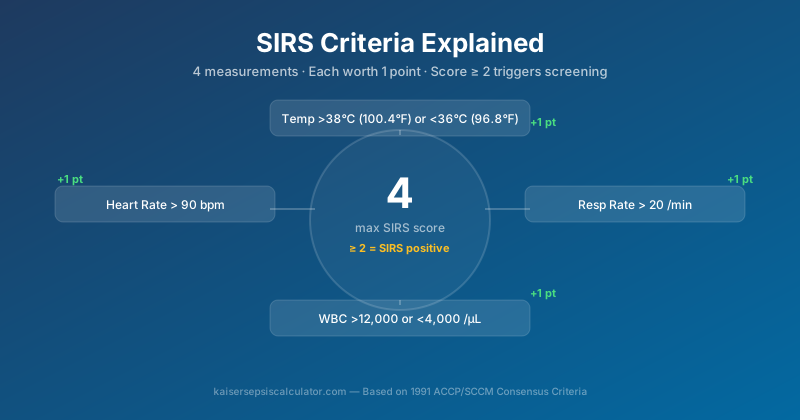
SIRS criteria were developed to answer a specific clinical question: how do you identify, in a reproducible and standardized way, that a patient's body has mounted a systemic inflammatory response? The answer that emerged from the 1991 ACCP/SCCM Consensus Conference was four measurable physiologic variables (temperature, heart rate, respiratory rate, and white blood cell count), each with defined thresholds.
The framework changed how clinicians communicate about sick patients. For the first time, there was a common language that nurses, physicians, and researchers could all use to describe the same physiologic state. For over two decades, meeting SIRS criteria plus having a suspected infection was the standard definition of sepsis. That definition wasn't retired until Singer et al. published the Sepsis-3 consensus in *JAMA* in 2016.
Understanding the four SIRS criteria in detail (what each one measures, why the thresholds are where they are, and where each one fails) is foundational knowledge for anyone involved in sepsis recognition.
Criterion 1: Temperature
Threshold: Temperature >38°C (100.4°F) OR <36°C (96.8°F)
Temperature is the most intuitive SIRS criterion. Fever represents the hypothalamic response to pyrogenic cytokines (primarily interleukin-1β, interleukin-6, and tumor necrosis factor-alpha) released during infection or tissue injury. The hypothalamus resets its thermal set-point upward, and the body generates heat through shivering and increased metabolic rate.
The 38°C cutoff is conservative. Many institutions use 38.3°C as a clinical fever threshold, but 38.0°C was chosen for SIRS to maximize sensitivity. A patient who reaches 38.1°C technically meets this criterion.
The hypothermia threshold of 36°C is equally important and frequently underappreciated. Hypothermic sepsis occurs when the inflammatory response is severely impaired, as in elderly patients with diminished reserve, neonates, patients on immunosuppressive agents, and those with overwhelming sepsis who have exhausted compensatory mechanisms. Several retrospective analyses have shown that septic patients presenting with hypothermia carry higher ICU mortality than those who present with fever, partly because the blunted response delays recognition.
Measurement method matters. Oral temperatures run approximately 0.3°C lower than core temperature. Rectal temperatures are the most accurate peripheral measure but rarely performed in adults. Axillary temperatures are the least reliable. In critically ill patients where accurate temperature is clinically important, a urinary bladder catheter with a thermistor or esophageal probe provides continuous core temperature monitoring.
Criterion 2: Heart Rate
Threshold: Heart rate >90 beats per minute
Tachycardia in the context of SIRS reflects the cardiovascular system's compensatory response to systemic vasodilation and early tissue hypoperfusion. Inflammatory mediators, particularly nitric oxide, cause peripheral vasodilation that reduces systemic vascular resistance. To maintain cardiac output and tissue perfusion pressure, the heart increases its rate.
The 90 bpm threshold was chosen as a value above which resting tachycardia in an adult indicates physiologic stress rather than normal variation. Resting heart rates of 70–85 bpm are typical for healthy adults. Rates above 90 in a resting, supine patient without another explanation (pain, anxiety, caffeine, dehydration) represent a meaningful departure.
The key clinical caveat is pharmacologic blunting. Patients on beta-blockers (a common medication in elderly patients with hypertension or heart failure) may not mount expected tachycardia even in the presence of sepsis. A heart rate of 78 bpm in a patient on metoprolol 100 mg daily who has a pulmonary infiltrate and fever should not be reassuring. The medication has suppressed the normal compensatory response.
Similarly, patients with pacemakers or fixed-rate atrial fibrillation will not show the dynamic heart rate changes that characterize early sepsis in physiologically intact patients.
Heart rate variability has emerged as a potentially more sensitive metric than raw heart rate. Reduced heart rate variability (less beat-to-beat fluctuation) correlates with severity of illness in sepsis (Buchman et al., *Critical Care Medicine*, 2010). But this isn't captured in standard SIRS criteria.
Criterion 3: Respiratory Rate
Threshold: Respiratory rate >20 breaths/min OR PaCO₂ <32 mmHg
Tachypnea in SIRS reflects one of two underlying processes, or both simultaneously. First, direct pulmonary involvement: pneumonia, pleural effusion, pulmonary edema, or ARDS all increase the work of breathing and drive the respiratory rate upward. Second, metabolic compensation: a falling serum pH from lactic acidosis or other metabolic derangements drives the respiratory center to increase minute ventilation to blow off CO₂ and buffer the acidosis.
The 20 breaths/min threshold is modest. Normal adult respiratory rate is 12–18 breaths per minute. A rate of 21 qualifies for this SIRS criterion. This sensitivity is by design: any significant increase in respiratory drive should be captured early.
The PaCO₂ <32 mmHg alternative is the laboratory surrogate for hyperventilation. When arterial blood gases are obtained, a PaCO₂ below 32 confirms that the patient is blowing off CO₂ in excess, regardless of whether the measured respiratory rate crossed the 20-breath threshold. This matters because, as noted in several studies, bedside respiratory rate documentation in hospitalized patients is frequently inaccurate. Nurses may count for 15 seconds and extrapolate, or enter an estimated value rather than a counted one. The ABG-based criterion captures hyperventilation that the documented rate may miss.
Pulse oximetry, while not part of the formal SIRS criteria, works as a practical supplement. SpO₂ below 94% on room air in the setting of tachypnea and fever provides additional physiologic support for the clinical picture even when ABGs are not yet available.
Criterion 4: White Blood Cell Count
Threshold: WBC >12,000/μL OR <4,000/μL OR >10% band forms (immature neutrophils)
The leukocyte criterion is the only SIRS criterion that requires a blood test, which means it isn't immediately available at the bedside and introduces a delay compared to the three vital-sign criteria.
Leukocytosis above 12,000/μL is the most commonly met leukocyte threshold. Infection triggers demargination of neutrophils from vascular walls and early release from bone marrow stores, producing an acute leukocytosis within 2–6 hours of infectious challenge.
Leukopenia below 4,000/μL indicates either consumption of neutrophils beyond the marrow's ability to replace them, or bone marrow suppression. This pattern is seen in severe sepsis, overwhelming gram-negative bacteremia, and in patients with underlying hematologic suppression from chemotherapy or HIV. Like hypothermia, leukopenia in the context of sepsis is an ominous finding associated with higher mortality.
>10% band forms reflects the release of immature neutrophils (bands) from the marrow: a "left shift" indicating that the demand for circulating neutrophils has outstripped the supply of mature cells. A normal differential has fewer than 5% bands. A band count above 10% indicates accelerated neutrophil production under inflammatory stress. This can be present even when the total WBC count is within the normal range, making it a sensitive adjunctive marker.
In practice, many facilities report WBC and differential together. A WBC of 11,500 with 14% bands technically meets the SIRS criterion on the basis of the band percentage alone, even though the total count does not exceed 12,000.
The Two-of-Four Rule and Why It Was Chosen
The original 1991 consensus set two of four criteria as the SIRS threshold. One criterion was felt to be too nonspecific (tachycardia alone could be anxiety or pain). Three or four criteria would miss too many early sepsis cases. Two of four was the compromise.
In retrospect, even two of four proved extraordinarily nonspecific in real-world populations. The Churpek et al. analysis of 269,000 hospitalized ward patients published in *JAMA Internal Medicine* (2015) found that 47% of all patients met SIRS criteria at some point during their stay. The vast majority did not have sepsis.
This sensitivity/specificity trade-off is the central limitation of SIRS as a sepsis definition. It will catch nearly all true sepsis cases (sensitivity approaching 83–85%), but it generates an enormous number of false positives that don't require sepsis-level resources.
Worked Example: Scoring a Patient Against SIRS Criteria
A 72-year-old male presents with two days of chills, productive cough, and confusion. His triage vitals are:
- Temperature: 38.8°C → SIRS criterion MET (>38°C)
- Heart rate: 102 bpm → SIRS criterion MET (>90)
- Respiratory rate: 23 breaths/min → SIRS criterion MET (>20)
- WBC: 9,800/μL with 4% bands → criterion NOT met
SIRS score: 3/4, positive. This patient meets SIRS criteria and has a clinically suspected infectious source (productive cough suggesting pneumonia). Under the pre-2016 definition, he meets the definition of sepsis. Under Sepsis-3, the clinician needs to assess for organ dysfunction via SOFA components. The new confusion may alone satisfy that threshold.
Now change the WBC to 13,500/μL with 12% bands and all four SIRS criteria are met. Same clinical urgency, but a higher inflammatory burden signaled by the leukocytosis and bandemia.
The Specificity Problem and What Replaced SIRS
SIRS was criticized for exactly the problem outlined above: it fires too broadly. A patient who just completed a marathon, a patient in postoperative day one after an appendectomy, and a patient having a lupus flare can all meet SIRS criteria with no infection whatsoever.
The Sepsis-3 task force responded by dropping SIRS as the physiologic anchor for sepsis diagnosis and replacing it with the SOFA score, a six-organ dysfunction assessment that requires lab results but is far more specific for the life-threatening physiology that actually defines sepsis. For the bedside, they introduced qSOFA as a quick three-item screen that doesn't require labs at all.
This doesn't mean SIRS is obsolete. SIRS retains clinical utility as a high-sensitivity screening trigger. It catches patients who need a sepsis workup even before organ dysfunction is evident. Many institutions continue using SIRS as the entry criterion for sepsis alert systems, accepting the high false-positive rate in exchange for earlier identification of true sepsis cases.
For a side-by-side comparison of how SIRS and qSOFA perform against each other in prospective clinical studies, see our post on qSOFA vs. SIRS scoring performance. For the full story of how the Sepsis-3 task force moved the clinical definition beyond SIRS, see our article on the distinction between SIRS and sepsis diagnosis.
Using SIRS Criteria in Practice
The most effective use of SIRS criteria is as a structured bedside trigger. Not as a definitive diagnosis, but as a standardized signal to initiate further evaluation. When two or more criteria are present in a patient with a plausible infectious source, the appropriate response is:
- Obtain blood cultures (two sets before antibiotics)
- Measure serum lactate
- Order a urinalysis and chest X-ray as clinically indicated
- Begin empirical antibiotics appropriate to the suspected source
The SIRS framework helps ensure this workup isn't delayed by normalcy bias. A patient with heart rate of 94 and temperature of 38.2°C might not look dramatically ill, but they meet two SIRS criteria, and with a suspected source that's enough to begin the evaluation.
To apply SIRS criteria to a specific clinical presentation in a structured format, run a quick risk assessment with the Kaiser Sepsis Calculator and see which thresholds are met in real time.
If you want to walk through the worked example above with your own patient's values, our sepsis risk calculator lets you enter each SIRS variable and immediately see how many criteria are met.
For information on our methodology and sources, visit our editorial team's approach page.