qSOFA vs. SIRS Score: Which Screening Tool Wins?
qSOFA vs SIRS compared side-by-side: sensitivity, specificity, clinical use cases, and why Sepsis-3 changed the standard of care.
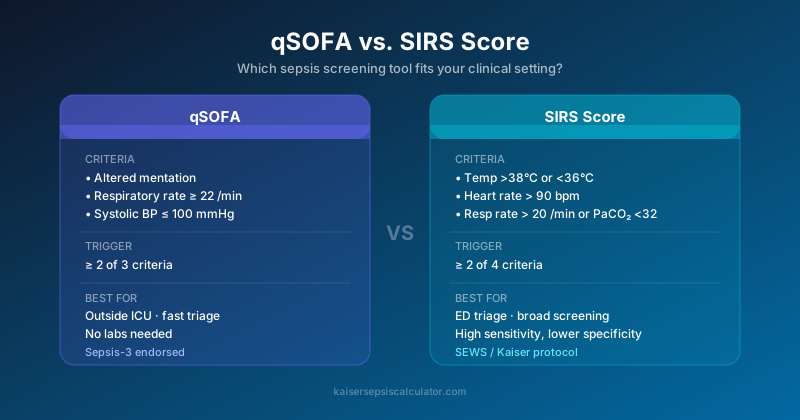
The debate over qSOFA vs SIRS isn't academic. It shapes which patients get sepsis workups, which get antibiotics within the hour, and which get sent home. Getting the wrong answer has real consequences. Septic shock mortality runs around 40%, and every hour of delayed treatment adds roughly 7% to that number.
Both scoring systems have been used at the bedside for decades. But since Sepsis-3 landed in 2016, clinicians have been forced to pick sides, or learn when each tool earns its place.
What SIRS Actually Measures
SIRS, or Systemic Inflammatory Response Syndrome, was developed in 1991 by Bone et al. to describe the body's nonspecific inflammatory cascade. It uses four criteria:
- Temperature >38°C or <36°C
- Heart rate >90 bpm
- Respiratory rate >20 breaths/min or PaCO₂ <32 mmHg
- White blood cell count >12,000 or <4,000 cells/μL, or >10% bands
Two or more criteria define SIRS. It casts a wide net by design. The original goal was to identify patients early, before obvious deterioration.
The problem is how wide that net actually is. Studies have shown that up to 47% of general ward patients meet SIRS criteria at some point during their admission, many of them without any infection. Pancreatitis, trauma, burns, and even vigorous exercise can all trigger SIRS. Specificity is low, roughly 15–25% depending on the population studied.
Still, for raw sensitivity in detecting infection-driven organ dysfunction in unselected ward patients, SIRS performs reasonably well: around 83–85% in prospective studies (Churpek et al., *Critical Care Medicine*, 2017). That means SIRS misses about 15% of true sepsis cases. A meaningful gap, but better than some alternatives.
What qSOFA Actually Measures
qSOFA (quick Sequential Organ Failure Assessment) was introduced alongside Sepsis-3 in 2016. It uses only three variables:
- Altered mental status (new confusion or GCS change)
- Respiratory rate ≥22 breaths/min
- Systolic blood pressure ≤100 mmHg
A score of ≥2 out of 3 was proposed as a trigger for further sepsis evaluation outside the ICU. qSOFA was designed to identify patients already progressing toward organ dysfunction, not merely patients with inflammation.
This is the core distinction. SIRS flags inflammation. qSOFA flags early hemodynamic and neurological compromise, signs that the infection has already started hurting organs.
The trade-off is sensitivity. Multiple studies have found qSOFA sensitivity in ward patients to be only 30–50% (Freund et al., *JAMA*, 2017; Seymour et al., *JAMA*, 2016). That means qSOFA misses half or more of sepsis cases when used as a standalone screen. For a bedside triage tool in the general ward, that's a significant limitation.
That said, qSOFA's specificity runs around 80–85% in the same populations. When qSOFA fires, it tends to mean something serious is happening.
The Head-to-Head Evidence
The Freund et al. study published in *JAMA* (2017) followed 879 patients across 30 EDs in France with suspected infection. For 28-day mortality prediction, qSOFA outperformed SIRS (AUROC 0.80 vs 0.65). But for sensitivity as a screening tool to catch all sepsis cases, SIRS remained superior.
A 2017 systematic review in *Critical Care* by Liang et al. pooled 38 studies covering over 500,000 patients. qSOFA showed sensitivity of 60.8% and specificity of 72.0% for sepsis-related mortality. SIRS showed sensitivity of 88.1% but specificity of only 26.5% for the same outcome. Neither tool dominates across both metrics simultaneously.
The takeaway from the literature is straightforward: choose your metric based on your clinical goal.
- If you want to catch everyone who might have sepsis (high sensitivity), SIRS is more appropriate as an initial screen.
- If you want to identify which infected patients are at highest risk of dying (high specificity, risk stratification), qSOFA performs better.
You can run a quick risk assessment using our tool, which integrates both SIRS-based criteria and the clinical context needed for real-world screening decisions.
Setting Matters Enormously
Sepsis-3 explicitly recommended qSOFA for outside the ICU: the ED, the general ward, and outpatient or pre-hospital settings where full labs may not be immediately available. All three qSOFA variables can be assessed in under 30 seconds with no blood work.
Inside the ICU, the full SOFA score (Sequential Organ Failure Assessment) is the Sepsis-3 standard. It evaluates six organ systems (respiratory, coagulation, hepatic, cardiovascular, neurological, and renal) and requires laboratory results. An increase of ≥2 SOFA points from baseline defines sepsis in Sepsis-3.
SIRS retains relevance in a few specific contexts:
- Initial ED triage when lab results are pending and qSOFA has not yet fired
- Antibiotic stewardship programs that need sensitive screening to ensure no sepsis patient is missed
- Research settings where the older definition is needed for historical comparability
When Each Tool Fails
SIRS fails in patients where the inflammatory response is blunted. Elderly patients on beta-blockers may not mount tachycardia. Immunocompromised patients may be afebrile despite bacteremia. Chronic kidney disease patients may have baseline leukocytosis. In these groups, a negative SIRS score provides false reassurance.
qSOFA fails earlier in the disease course, before hypotension and encephalopathy develop. A patient with early sepsis, intact blood pressure, and normal mentation will score 0 on qSOFA despite active infection. Relying on qSOFA alone in a primary care or triage setting risks sending these patients home.
The failure modes run in opposite directions. SIRS over-identifies. qSOFA under-identifies early disease.
A Complementary Approach
The most defensible clinical approach uses both tools in sequence. Screen broadly with SIRS criteria. Use qSOFA as a rapid risk-stratification step when SIRS is positive. A patient who meets SIRS criteria and also scores ≥2 on qSOFA has significantly higher mortality risk than either tool alone would suggest.
The 2021 Surviving Sepsis Campaign guidelines acknowledge this tension and recommend clinical judgment alongside any scoring system. No algorithm replaces careful history-taking, physical examination, and knowledge of the patient's baseline.
For a full breakdown of how SIRS criteria are defined and scored, see our post on SIRS criteria explained. The evolution of sepsis definitions (including why Sepsis-3 moved away from SIRS as the primary definition) is covered in detail in our article on Sepsis-3 definition changes.
Practical Takeaways for the Bedside
A patient arrives with suspected pneumonia. Temperature is 38.4°C, HR 96, RR 18, WBC 14,000. SIRS score: 3/4, positive. qSOFA: RR <22, BP normal, alert. qSOFA score: 0/3, negative.
What do you do? The patient has clear SIRS-positive status from an infectious source. Despite a negative qSOFA, this patient warrants blood cultures, early antibiotics, and lactate measurement. qSOFA negativity doesn't rule out sepsis. It suggests lower short-term mortality risk, not absence of infection.
Now consider a second patient: temperature 37.2°C, HR 88, but BP is 98/62, RR 24, confused. SIRS score: 2/4, positive. qSOFA score: 3/3, strongly positive. This patient has a much higher probability of 28-day mortality and requires urgent intervention regardless of whether cultures are back.
The tools complement each other. Neither replaces clinical judgment. Both should be part of every clinician's working knowledge.
Use the Kaiser Sepsis Calculator to score patients against these criteria in real time. It applies both frameworks and flags which thresholds have been crossed.
The Bottom Line
qSOFA and SIRS answer different questions. SIRS asks: "Is there systemic inflammation?" qSOFA asks: "Is this patient deteriorating toward organ failure?" Choosing the right tool depends on where you are in the clinical encounter and what decision you need to make.
Neither tool should be used in isolation. Neither has been validated as a standalone rule-out criterion. Used together, with clinical context, they provide a more complete picture than either offers alone.
For more on how our team approaches sepsis risk assessment tools, visit our about page.