How Sepsis-3 Changed the Definition of Sepsis in 2016
The Sepsis-3 definition abandoned SIRS in 2016, replacing it with organ dysfunction via the SOFA score. Learn what Singer et al. changed and why it matters clinically.
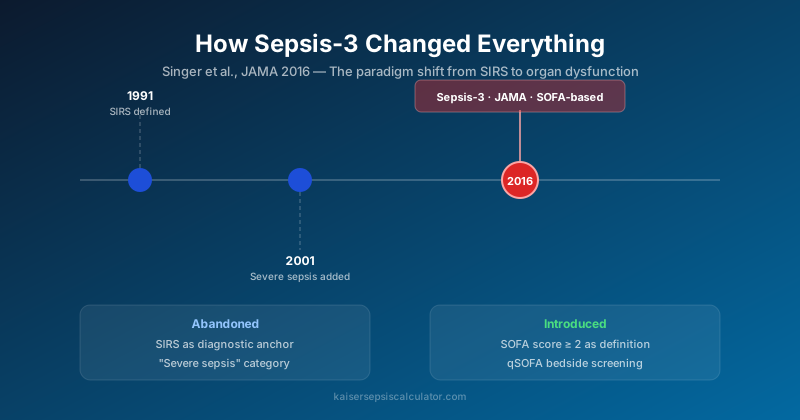
The 2016 sepsis consensus paper arrived not with new science but with a new framework for an old problem. The authors weren't announcing a discovery. They were correcting a definition that had been in place for 25 years and had quietly accumulated enough clinical problems that continuing to use it was no longer defensible. Singer et al. published the Sepsis-3 definitions in *JAMA* on February 23, 2016, and the document changed how hospitals classify, code, and treat one of medicine's most lethal syndromes.
The Problem With the 1991 Definition
The original sepsis definition was established at the 1991 American College of Chest Physicians/Society of Critical Care Medicine Consensus Conference. The framework that emerged, organized around Systemic Inflammatory Response Syndrome (SIRS), was the first attempt to give sepsis a standardized, measurable clinical definition. It worked reasonably well as a starting point.
Under the 1991 framework, clinicians categorized patients into a spectrum:
- SIRS: Two or more of four criteria (temperature abnormality, tachycardia, tachypnea, WBC abnormality)
- Sepsis: SIRS plus documented or suspected infection
- Severe sepsis: Sepsis plus acute organ dysfunction, hypoperfusion, or hypotension
- Septic shock: Severe sepsis plus refractory hypotension despite adequate resuscitation
By 2001, a follow-up consensus conference had updated the criteria slightly and added additional diagnostic variables, but the core SIRS-based architecture remained intact.
The problem was specificity. SIRS criteria fire in response to virtually any physiologic stress, not just infection. Post-surgical patients, burn victims, pancreatitis patients, patients with autoimmune flares, and even athletes after extreme exertion can meet two or more SIRS criteria. The Churpek et al. analysis (*JAMA Internal Medicine*, 2015) of 269,000 hospitalized patients found that 47% met SIRS criteria at some point during their admission. Adding "suspected infection" narrowed the definition somewhat, but not enough.
The clinical consequence was a diagnostic category that was simultaneously over-inclusive (capturing patients who didn't have the life-threatening syndrome sepsis describes) and potentially under-inclusive (missing patients whose infection-driven organ dysfunction wasn't accompanied by dramatic SIRS-positive vital signs).
"Severe sepsis" created a second structural problem. The intermediate category (sepsis plus organ dysfunction) was clinically meaningful, but it created confusion in practice. Most clinicians treating a patient with infection-driven organ dysfunction weren't managing two different diseases depending on whether the hypotension threshold had been crossed. They were managing one disease with varying severity. The three-tier structure added terminology without adding precision.
What Singer et al. Changed in JAMA 2016
The Sepsis-3 task force, 19 critical care experts from Europe and North America chaired by Mervyn Singer, undertook a systematic review of the evidence and proposed three foundational changes.
Change 1: A New Definition of Sepsis
Sepsis is now defined as life-threatening organ dysfunction caused by a dysregulated host response to infection.
This single sentence is the conceptual foundation of Sepsis-3. The critical move is the shift in what defines sepsis: not SIRS (a physiologic response that can occur without infection) and not infection alone (which millions of people have without sepsis), but specifically the organ dysfunction that results when infection triggers a dysregulated host immune response.
This definition better captures the biology. Sepsis isn't dangerous because of fever and tachycardia. It's dangerous because of what those inflammatory responses do to organ systems when they spiral out of control. The kidneys, liver, brain, lungs, and cardiovascular system are injured by cytokine storms, microvascular thrombosis, endothelial damage, and metabolic failure. SIRS criteria were a proxy for this process. The new definition targets the process directly.
Change 2: Elimination of "Severe Sepsis"
The category of severe sepsis was removed entirely. Under Sepsis-3, the spectrum runs from sepsis (infection plus organ dysfunction) directly to septic shock (sepsis plus vasopressor requirement plus lactate above 2 mmol/L despite adequate resuscitation).
The old category "sepsis" (meaning SIRS plus infection without organ dysfunction) is no longer classified as sepsis. It's simply infection with systemic inflammatory features. This reclassification was controversial at the time of publication because it affected how hospitals coded diagnoses and tracked outcomes, but the task force argued (persuasively) that a definition should reflect biological reality rather than administrative convenience.
The elimination of severe sepsis means that any patient who meets the new sepsis definition already has organ dysfunction. There is no "mild sepsis" in the Sepsis-3 framework. Infection without organ dysfunction is not sepsis. It's infection.
Change 3: Introduction of SOFA and qSOFA
To operationalize "organ dysfunction," the task force needed a measurable score. They adopted the Sequential Organ Failure Assessment (SOFA) score, which had been in use in ICU research for decades and evaluates six organ systems:
- Respiratory: PaO₂/FiO₂ ratio
- Coagulation: platelet count
- Liver: bilirubin
- Cardiovascular: mean arterial pressure and vasopressor requirements
- CNS: Glasgow Coma Scale
- Renal: creatinine and urine output
A baseline SOFA score is established (or assumed to be zero in patients without prior organ dysfunction), and an acute increase of ≥2 SOFA points from baseline in the context of suspected infection defines sepsis. The 2-point threshold was validated against clinical datasets as the threshold above which infection-associated organ dysfunction significantly increased mortality.
Because SOFA requires laboratory results (PaO₂/FiO₂, bilirubin, creatinine), the task force introduced qSOFA as a bedside screening tool that requires no labs at all. qSOFA uses three clinical variables:
- Altered mental status (any GCS decline, new confusion)
- Respiratory rate ≥22 breaths/min
- Systolic blood pressure ≤100 mmHg
A qSOFA score of ≥2 outside the ICU was proposed as a trigger for further sepsis evaluation, including full SOFA scoring. The Freund et al. validation study (*JAMA*, 2017) in 879 ED patients found that qSOFA predicted 28-day mortality with an AUROC of 0.80, compared to 0.65 for SIRS criteria, a substantial improvement in prognostic performance.
For a detailed side-by-side examination of how qSOFA performs against SIRS criteria across prospective clinical datasets, see our post on qSOFA vs. SIRS score: what the evidence shows.
The New Definition of Septic Shock
Septic shock under Sepsis-3 has a more specific and more demanding definition than its predecessor. It requires all three of:
- Sepsis (documented or suspected infection plus ≥2 SOFA point increase)
- Vasopressor requirement to maintain MAP ≥65 mmHg
- Serum lactate >2 mmol/L despite adequate fluid resuscitation
The original definition required only refractory hypotension despite fluid challenge. The Sepsis-3 definition adds lactate as a mandatory component, which captures a clinically distinct and more severely ill population. A patient maintained on vasopressors with a lactate of 1.5 mmol/L has sepsis, not septic shock by the current definition. The same patient with a lactate of 2.5 mmol/L crosses into septic shock, and faces hospital mortality exceeding 40% (Singer et al., *JAMA*, 2016).
The lactate requirement matters because it identifies patients with cellular oxygen delivery failure (the physiologic core of what makes septic shock lethal) independent of whether blood pressure is being artificially maintained. A patient on norepinephrine with a MAP of 66 can still be dying at the cellular level if lactate continues to rise.
Impact on Diagnosis Rates and Coding
One of the immediately measurable impacts of Sepsis-3 adoption was a shift in how sepsis was counted. Under the old definition, a patient with urinary tract infection, fever, and tachycardia (even if they recovered uneventfully on oral antibiotics) could be coded as sepsis. Under Sepsis-3, that same patient doesn't have sepsis unless organ dysfunction markers are present.
Multiple health systems reported a reduction in coded sepsis cases after adopting Sepsis-3 criteria, not because the patient population changed, but because the definition raised the diagnostic threshold. This created methodological challenges for epidemiological research comparing pre- and post-2016 sepsis rates, and it created administrative tension around hospital-reported quality metrics that used older sepsis ICD codes.
On the flip side, Sepsis-3 also identified a group of patients who were missed by the old framework: those with subtle organ dysfunction (rising creatinine, mildly elevated bilirubin, mild thrombocytopenia) in the context of infection, without dramatic SIRS-positive vital signs. These patients weren't previously classified as septic, but they carry meaningful mortality risk and benefit from early intervention.
Why SIRS Still Has a Role
The Sepsis-3 task force was careful not to dismiss SIRS as clinically useless. They explicitly noted that SIRS criteria retain value as a sensitive initial screen in settings where labs are not yet available and organ dysfunction cannot be assessed. A patient who meets SIRS criteria with suspected infection warrants an urgent workup (cultures, lactate, a SOFA calculation once labs return) even if they don't yet meet the organ dysfunction threshold.
SIRS-positive, SOFA-negative patients are not being discharged home with a reassurance that they don't have sepsis. They are being monitored, worked up, and treated for their infection aggressively, while the clinical picture develops. The distinction matters for prognosis, resource allocation, and research classification. It doesn't determine the immediate clinical response to a sick-appearing patient.
For a full analysis of how SIRS and sepsis relate to each other under both the old and new frameworks, see our post on the clinical distinction between SIRS and sepsis.
The Clinical Bottom Line From Sepsis-3
Three practical takeaways shape everyday sepsis care after 2016:
Organ dysfunction is the trigger, not vital signs alone. Fever and tachycardia in an infected patient warrant investigation, but the clinical urgency of a full sepsis response is anchored to evidence of organ dysfunction: rising creatinine, elevated bilirubin, falling platelets, altered mental status, worsening hypoxia.
Lactate is mandatory. Lactate ≥2 mmol/L is now part of both the septic shock definition and the Surviving Sepsis Campaign Hour-1 bundle. A normotensive patient with lactate between 2 and 4 mmol/L has "cryptic shock" (inadequate tissue perfusion without overt hypotension) and requires aggressive resuscitation.
qSOFA is a risk flag, not a rule-out. A qSOFA of 0 doesn't exclude sepsis. It predicts a lower short-term mortality risk but should not override clinical judgment in a patient with a compelling infectious presentation and laboratory evidence of early organ dysfunction.
The full Singer et al. paper, "The Third International Consensus Definitions for Sepsis and Septic Shock (Sepsis-3)," *JAMA* 2016;315(8):801–810, remains the primary reference document for current sepsis definitions worldwide.
To screen a patient against SIRS criteria and assess early organ dysfunction markers in a structured format, use our sepsis risk calculator to apply these thresholds in real time.
When you need to quickly check whether a patient's vital signs cross SIRS or qSOFA thresholds, run a quick risk assessment and see the criteria scored in seconds. For more about the editorial approach behind this resource, visit our clinical methodology overview.