Early Warning Signs of Sepsis: Vital Signs to Watch
Learn the sepsis early warning signs clinicians track: fever, tachycardia, altered mental status, and more. Acting within the first hour saves lives.
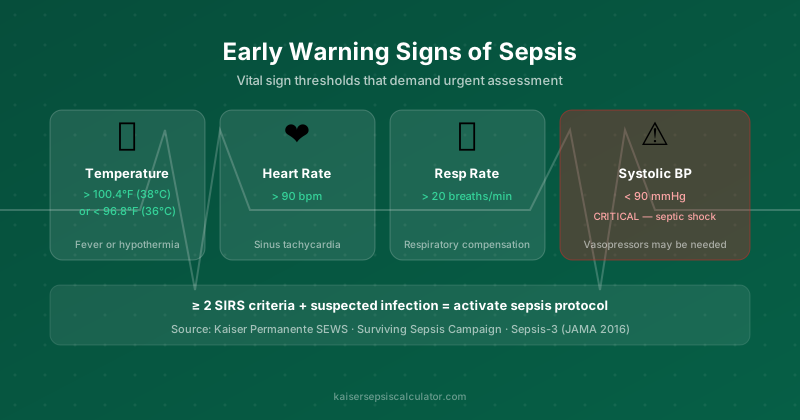
Sepsis kills more Americans each year than prostate cancer, breast cancer, and AIDS combined. The CDC estimates 1.7 million adults develop sepsis annually in the United States, and roughly 270,000 die. That mortality rate has stubbornly resisted broad improvement despite decades of research. The single most powerful intervention is time: recognizing sepsis early and starting antibiotics within the first hour cuts mortality by approximately 7% per hour of delay (Kumar et al., *Critical Care Medicine*, 2006).
That window belongs to whoever is at the bedside first, often a nurse, a paramedic, or a family member who notices something is wrong before a physician sees the patient. Understanding which vital sign changes and clinical features signal early sepsis isn't optional knowledge for anyone involved in direct patient care.
Why Early Recognition Is So Difficult
Sepsis does not announce itself with a single dramatic finding. It accumulates. A fever here, a mild confusion there, a heart rate that keeps creeping upward on serial checks. Early sepsis often looks like a moderately unwell patient who "just doesn't seem right," and that subjective assessment is frequently correct.
The physiologic explanation is that sepsis is driven by the host's own immune response rather than the pathogen alone. The cascade of cytokines, complement activation, and coagulation disturbances begins well before any single organ tips into frank failure. During this early window, the vital signs are abnormal but not catastrophically so, which is exactly when intervention is most effective.
By the time a patient becomes hypotensive, confused, and oliguric, they are approaching septic shock, a state carrying hospital mortality above 40% (Singer et al., *JAMA*, 2016). The goal is to identify these patients hours before that threshold.
The Six Clinical Features Clinicians Track
1. Fever or Hypothermia
The body's first response to infection is typically a temperature spike above 38°C (100.4°F) as the hypothalamus resets its thermostat in response to cytokine release. This is the most recognizable warning sign, and the one most people associate with infection.
But hypothermia tells a grimmer story. A temperature below 36°C (96.8°F) in the context of suspected infection indicates a severely blunted immune response, often seen in elderly patients, neonates, immunocompromised individuals, and patients in advanced septic states. Hypothermic sepsis carries higher mortality than febrile sepsis in multiple retrospective analyses. A cold, mottled patient with suspected infection isn't less sick. They're potentially more sick.
Both ends of the temperature spectrum qualify under SIRS criteria and should prompt aggressive evaluation.
2. Tachycardia
A resting heart rate above 90 bpm is one of the four SIRS criteria and one of the most sensitive early markers of physiologic stress. The heart accelerates to compensate for vasodilation and inadequate tissue perfusion. The cardiovascular system is trying to maintain cardiac output in the face of distributive physiology.
Tachycardia alone is nonspecific. Pain, anxiety, anemia, dehydration, and medication effects all raise the heart rate. But tachycardia in a patient who also has fever, an infectious source, and a subtle change in mental status is a pattern that demands sepsis be on the differential.
The absence of tachycardia does not rule out sepsis. Patients on beta-blockers, elderly patients with diminished chronotropic response, and patients with underlying dysrhythmias may not mount expected heart rate responses even in the face of significant hemodynamic compromise.
3. Tachypnea
A respiratory rate above 20 breaths per minute reflects one of two processes: either respiratory compensation for a metabolic acidosis (the lungs are blowing off CO₂ to buffer falling pH), or direct pulmonary involvement such as pneumonia or acute respiratory distress syndrome (ARDS).
Respiratory rate is the vital sign most frequently not measured accurately. Many nursing assessments record a default value of 18 or 20 rather than a counted rate. Studies have shown that manually counted respiratory rates capture significantly more abnormal readings than chart-recorded estimates (Philip et al., *Journal of Hospital Medicine*, 2015).
A PaCO₂ below 32 mmHg on arterial blood gas is the lab equivalent of tachypnea within the SIRS framework. It confirms hyperventilation is occurring even when the rate appears borderline.
4. Altered Mental Status
Any new change in cognition, orientation, or level of consciousness in a patient with suspected infection is a critical warning sign. It doesn't need to be dramatic. New confusion in a patient who was previously oriented, increased somnolence, agitation in a typically calm patient, subtle disorientation: all of these qualify.
The mechanism is multifactorial. Cytokine-driven neuroinflammation, microvascular dysfunction, hypoperfusion, and metabolic derangement from renal or hepatic involvement all contribute to what is clinically called sepsis-associated encephalopathy. It appears in up to 70% of ICU patients with sepsis (Gofton and Young, *Nature Reviews Neurology*, 2012).
Altered mental status also qualifies for a point on the qSOFA score. A patient with a new change in mentation, a systolic BP ≤100, and RR ≥22 scores 3/3 on qSOFA, the highest-risk category, associated with 24% in-hospital mortality even outside the ICU (Freund et al., *JAMA*, 2017).
5. Hypotension
Systolic blood pressure below 100 mmHg, or a mean arterial pressure below 65 mmHg, signals that the cardiovascular system is losing the compensation battle. In early sepsis, blood pressure is often preserved through compensatory tachycardia and vasoconstriction. Once hypotension appears, the patient has crossed a threshold where immediate aggressive resuscitation is mandatory.
Hypotension in the context of suspected infection that persists despite adequate fluid resuscitation, and requires vasopressors to maintain MAP ≥65, defines septic shock under the Sepsis-3 framework. Septic shock carries hospital mortality exceeding 40% and demands ICU-level care.
The challenge is that many patients, particularly young patients with good physiologic reserve, maintain normal blood pressure well into the sepsis trajectory. Blood pressure alone is an insensitive early marker. It must be interpreted alongside mental status, lactate, and signs of end-organ perfusion.
6. Elevated Lactate
A serum lactate ≥2 mmol/L is not a vital sign in the traditional sense but functions as a biochemical vital sign in sepsis care. Elevated lactate reflects tissue hypoperfusion. Cells are switching to anaerobic metabolism because oxygen delivery is inadequate.
The Surviving Sepsis Campaign guidelines recommend lactate measurement in all patients with suspected sepsis. A lactate between 2 and 4 mmol/L in a normotensive patient ("cryptic shock") carries mortality comparable to hypotensive sepsis in some studies. A lactate above 4 mmol/L is an independent indication for ICU admission and aggressive resuscitation regardless of blood pressure (Dellinger et al., *Critical Care Medicine*, 2013).
Lactate is also used to track treatment response. Lactate clearance of ≥10% over 2 hours has been associated with improved outcomes and is a target in several institutional protocols.
Clinical Scenarios: How These Signs Appear by Source
Pneumonia
The most common sepsis source. The patient typically presents with productive cough, pleuritic chest pain, fever, and fatigue. Early warning signs often include temperature above 38.5°C, HR 95–105, RR 22–24. Mental status changes in elderly patients, even without dramatic fever, should raise sepsis concern immediately. Pulse oximetry below 94% on room air adds urgency.
Urinary Tract Infection
UTI is the leading sepsis source in women and in catheterized patients. Warning signs can be subtle: low-grade fever, mild tachycardia, and new confusion, particularly in elderly patients who may not complain of classic dysuria. The absence of urinary symptoms does not exclude urosepsis. Any cognitively impaired, institutionalized patient with new vital sign changes warrants a urinalysis and culture.
Abdominal Source
Biliary sepsis (cholangitis), perforated viscus, and ischemic bowel can progress to septic shock with alarming speed. These patients often have abdominal rigidity or guarding, but early presentations may show only fever, tachycardia, and a rising lactate before the abdomen becomes clinically dramatic.
Soft Tissue / Wound Infection
Necrotizing fasciitis can kill within hours of apparent skin findings. Any wound with disproportionate pain (pain beyond what the wound appearance suggests), rapid spread, systemic signs, or crepitus on palpation requires immediate surgical consultation regardless of how the vital signs appear.
The Time Window That Determines Outcomes
The 2006 Kumar et al. study remains the landmark reference: for every hour antibiotics are delayed after septic shock onset, survival decreases by approximately 7.6%. By 6 hours of delay, effective therapy had dropped below 50% for some pathogens.
More recent data from the SEP-1 bundle implementation showed that hospitals achieving the 3-hour bundle (blood cultures, lactate, antibiotics) within the target window had significantly lower mortality than those that did not. The mechanism is straightforward. Early antibiotics reduce pathogen burden before organ dysfunction escalates to the point of irreversibility.
This is why early warning signs matter so much. Identifying them an hour earlier, before hypotension develops, before lactate climbs above 4, before the patient becomes unresponsive, can mean the difference between a patient who goes home in a week and one who requires prolonged ICU care or does not survive.
How Screening Tools Fit Into Early Recognition
No single warning sign catches all sepsis cases. Protocols work better than intuition alone. The SIRS criteria provide a structured four-variable screen that nurses and physicians can apply at any bedside without laboratory results for three of the four criteria. The qSOFA score provides a three-variable bedside check that takes under 30 seconds. Used together, they cover different parts of the clinical picture.
For a structured breakdown of exactly how the SIRS criteria are defined and scored, see our post on SIRS criteria and their exact clinical thresholds. For information on what happens after sepsis is identified (the treatment bundles and time targets), see our post on the sepsis treatment bundle and hour-1 targets.
If you are working through a clinical presentation and want to apply these criteria systematically, use our bedside screening tool to score a patient against SIRS criteria and early sepsis flags in real time.
When time is short and you need a rapid structured check at the bedside, check the SIRS score calculator to run through all four criteria without having to recall each threshold from memory.
Acting on What You See
The clinical instinct that "this patient looks sick" is frequently right, and frequently discounted because no single number is yet dramatically abnormal. The warning signs described above rarely appear in isolation. A patient with fever, mild tachycardia, and slightly increased respiratory rate from a known pneumonia is showing you three of four SIRS criteria. Add any change in mental status from their baseline and you have a four-variable picture that demands a sepsis workup.
Don't wait for hypotension. Don't wait for confusion to become unresponsiveness. The time window to change outcomes with early antibiotics, cultures, and fluid resuscitation closes faster than most clinicians expect.
To learn more about the team behind this resource and our approach to clinical decision support, visit our clinical team overview page.