Septic Shock vs. Severe Sepsis: The Clinical Spectrum
Septic shock vs severe sepsis explained: why Sepsis-3 eliminated one term, current definitions, mortality rates, and what the clinical spectrum means for treatment.
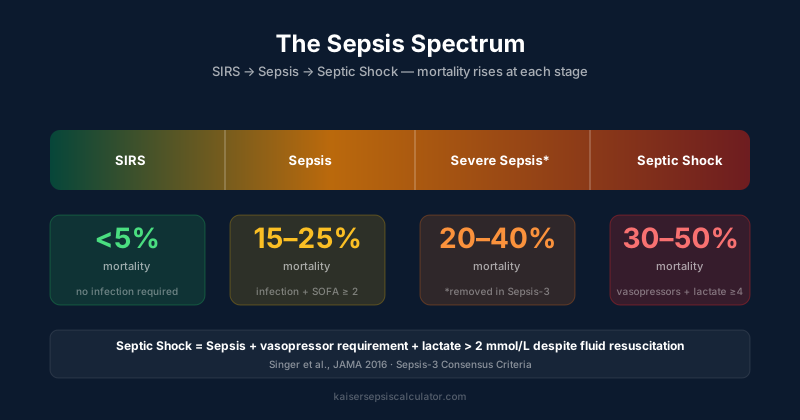
For two decades, clinicians were taught to think about sepsis as a spectrum: SIRS led to sepsis, sepsis progressed to severe sepsis, and severe sepsis could tip into septic shock. That framework governed training programs, order sets, and hospital policies from 1991 to 2016. Then the Sepsis-3 consensus definitions dismantled two of those four tiers and replaced the entire model.
Understanding why the change happened, and what the current definitions actually require, matters for every clinician who manages infected patients.
The Old System: Four Categories
The 1991 ACCP/SCCM consensus conference, driven largely by Roger Bone and colleagues, established four progressive categories:
SIRS (Systemic Inflammatory Response Syndrome): ≥2 of 4 criteria (temperature abnormality, tachycardia, tachypnea, leukocytosis or leukopenia). Could be triggered by infection or non-infectious causes.
Sepsis: SIRS caused by a confirmed or suspected infection.
Severe sepsis: Sepsis plus acute organ dysfunction, defined by evidence of hypoperfusion or organ failure (elevated creatinine, elevated bilirubin, thrombocytopenia, altered mental status, hypoxia requiring supplemental O₂, or lactate ≥1 mmol/L above normal).
Septic shock: Severe sepsis plus refractory hypotension, defined as SBP <90 mmHg or MAP <70 mmHg for at least 1 hour despite adequate fluid resuscitation, OR requiring vasopressors to maintain that blood pressure target.
This four-tier model was intuitive and teachable. Its limitation was clinical imprecision, particularly the broad, loosely defined criteria for "severe sepsis" and the ambiguity around what constituted "adequate fluid resuscitation."
Why the Sepsis-3 Task Force Eliminated "Severe Sepsis"
The Sepsis-3 guidelines, published in *JAMA* in February 2016, were the product of a 19-member task force convened by the Society of Critical Care Medicine and the European Society of Intensive Care Medicine. Their mandate was to update the definitions based on two decades of accumulated evidence.
The task force identified several core problems with the old system:
SIRS criteria weren't specific enough. Studies showed that healthy volunteers, post-surgical patients, and patients with non-infectious inflammatory conditions all met SIRS criteria regularly. Using SIRS-positive status as the entry point for "sepsis" inflated prevalence estimates and created a low bar that didn't distinguish well between patients who needed aggressive intervention and those who didn't.
"Severe sepsis" was redundant. The task force argued that organ dysfunction is the defining feature of sepsis. It's what makes sepsis life-threatening. Therefore, "severe sepsis" (sepsis with organ dysfunction) was simply sepsis by the new definition. The modifier "severe" was eliminated because, in the Sepsis-3 framework, all sepsis implies organ dysfunction.
The old definitions performed poorly in outcome prediction. When the task force ran the criteria through databases covering over 1.3 million patient encounters, SIRS-based definitions had poor discriminatory ability for in-hospital mortality compared to SOFA-based definitions.
The result was a two-tier system: sepsis and septic shock.
The Current Sepsis-3 Definitions
Sepsis is now defined as life-threatening organ dysfunction caused by a dysregulated host response to infection. Clinically, this means:
- Suspected or confirmed infection
- Acute increase in SOFA score ≥2 points from baseline
The SOFA score (Sequential Organ Failure Assessment) evaluates six organ systems and generates a total score from 0 to 24. A baseline SOFA of 0 is assumed in patients without known prior organ dysfunction. An acute rise of ≥2 points corresponds to an estimated in-hospital mortality of approximately 10%. That was the threshold the task force chose to define "life-threatening."
Outside the ICU, where full SOFA calculation may not be practical, qSOFA ≥2 (altered mentation, RR ≥22, SBP ≤100) serves as a bedside prompt for further sepsis assessment. Use our sepsis risk calculator to work through these criteria at the bedside.
Septic shock is defined as a subset of sepsis in which circulatory, cellular, and metabolic abnormalities are significant enough to substantially increase mortality. The clinical criteria:
- Sepsis (as above)
- Vasopressor requirement to maintain MAP ≥65 mmHg
- Serum lactate >2 mmol/L despite adequate fluid resuscitation
Both criteria must be present simultaneously. A patient on vasopressors with lactate 1.8 mmol/L does not meet the Sepsis-3 definition of septic shock. A patient with lactate 3.4 mmol/L but responsive blood pressure doesn't either. This dual requirement was intentional. It identifies a population with both hemodynamic failure and tissue-level metabolic compromise.
Mortality at Each Level
The mortality differences between sepsis and septic shock are clinically significant and drive treatment urgency.
Sepsis (Sepsis-3 definition, organ dysfunction present): In-hospital mortality approximately 10–20%, depending on organ systems involved, age, comorbidities, and time to treatment. Mortality rises steeply with the number of failing organ systems. Two or more failing organ systems carries roughly 30% mortality even without meeting septic shock criteria.
Septic shock (Sepsis-3 definition): In-hospital mortality approximately 40–45% in high-income country ICUs. A 2016 analysis of the Sepsis-3 task force dataset found septic shock mortality at 42.3% compared to 26.7% in patients meeting Sepsis-3 sepsis criteria only (Shankar-Hari et al., *JAMA*, 2016).
For context: the old "severe sepsis" category had mortality estimates ranging widely from 20% to 30% depending on the study. Its elimination reduced heterogeneity in reported outcomes and allowed more accurate comparisons across institutions and trials.
Case Examples
Case 1, sepsis without shock: A 58-year-old with community-acquired pneumonia. Temperature 38.9°C, HR 104, RR 22, BP 112/70, GCS 15. Creatinine is 2.1 mg/dL (baseline 0.9 mg/dL), suggesting acute kidney injury. Lactate is 2.8 mmol/L. SOFA score increases by 3 points from baseline. This patient meets the Sepsis-3 definition of sepsis. No vasopressors required. Under the old system, this would have been "severe sepsis." Under Sepsis-3, it's simply sepsis, but the lactate and AKI flag that this patient is at meaningful risk of deterioration.
Case 2, septic shock: A 71-year-old with a urinary source, now 6 hours into the ED course. Despite 2 liters of lactated Ringer's, BP is 84/52 (MAP 63). Norepinephrine started at 0.08 mcg/kg/min to maintain MAP ≥65. Repeat lactate after resuscitation: 3.6 mmol/L. This patient meets septic shock criteria. Mortality risk: approximately 40%. ICU admission, early antibiotic optimization, and reassessment of fluid responsiveness are all mandatory.
The Vasopressor + Lactate Threshold: Why Both?
The requirement for both vasopressor dependence and post-resuscitation lactate >2 mmol/L was validated specifically to identify a population with at least 40% in-hospital mortality. This dual threshold excludes:
- Patients who are vasopressor-dependent due to distributive causes without significant lactate elevation (e.g., some distributive shock states from neurogenic causes)
- Patients with elevated lactate due to non-circulatory causes (e.g., metformin-associated lactic acidosis, thiamine deficiency, liver failure) who respond to volume
It's a tight definition by design. The task force wanted "septic shock" to mean something precise. A population sick enough that clinical trials could demonstrate intervention effects and institutions could meaningfully track outcomes.
How Source and Timing Interact with Severity
The clinical severity trajectory, from sepsis to septic shock, isn't inevitable, but it is rapid. Data from the ProCESS trial and the Rivers et al. landmark EGDT study suggest that patients who present in septic shock have typically been deteriorating for hours before their first medical contact.
This is why early recognition matters more than categorization. Identifying sepsis before shock develops is the single most effective intervention available. The Sepsis-3 definition changes article explains how the criteria evolved to support earlier, more accurate identification.
The sepsis treatment bundle is the operational response, and it applies to both sepsis and septic shock, with vasopressor initiation added for the latter.
Clinical Implications of the New System
Documentation: Coders and quality teams need to understand that "severe sepsis" is no longer a valid Sepsis-3 term. If your institution uses Sepsis-3 definitions for reporting, orders should reflect sepsis or septic shock only. Some ICD-10 codes still reference "severe sepsis," and this creates an ongoing documentation challenge at the interface between clinical and administrative medicine.
SEP-1 vs. Sepsis-3: The Centers for Medicare & Medicaid Services (CMS) SEP-1 quality bundle uses a modified version of the Sepsis-2 definitions, not Sepsis-3. That means sepsis-eligible patients for SEP-1 compliance purposes are defined differently from those who meet Sepsis-3 criteria. Clinicians at institutions that track SEP-1 compliance need to understand both frameworks.
Prognostic conversations: When explaining prognosis to patients and families, the shift from "severe sepsis" to "septic shock" has meaningful implications. Patients who meet septic shock criteria are facing roughly 4 times the mortality risk of the average medical inpatient. Those conversations deserve precision.
For guidance on how our editorial team approaches clinical accuracy and medical sourcing, visit our clinical review page.
The Bottom Line
The old four-tier model (SIRS, sepsis, severe sepsis, septic shock) has been replaced by two categories. Sepsis now means organ dysfunction from infection, regardless of whether the patient has hypotension. Septic shock requires both vasopressor dependence and elevated post-resuscitation lactate. Mortality runs approximately 10–20% for sepsis and 40–45% for septic shock.
The elimination of "severe sepsis" wasn't a semantic exercise. It reflected the task force's conclusion that organ dysfunction is the defining characteristic of life-threatening infection, and that grouping patients by inflammatory markers alone (SIRS) was imprecise enough to harm care quality.
Screen early, treat fast, and know exactly what you're calling it. Use the Kaiser Sepsis Calculator to apply Sepsis-3 criteria systematically at the bedside.